Using Comics
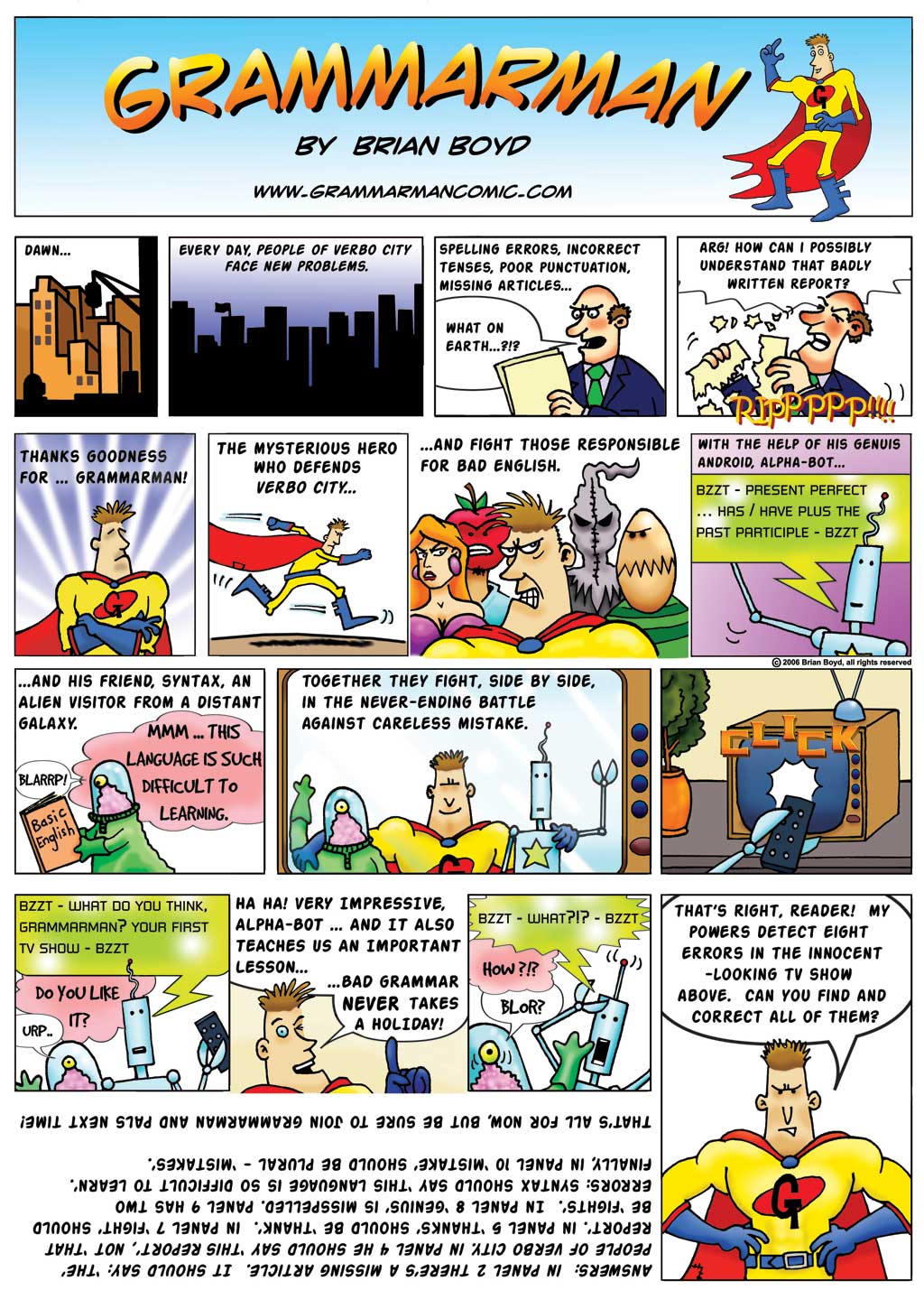
Comics are a great source of inspiration especially for teenagers and a pioneer in using these in ELT is Grammarman and he has kindly let me use his first episode to illustrate some of the activities that you can do with comics, especially for those of us that can't draw to save our lives...
Guess the caption
You can either do this electronically using a graphics package or good old Tippex (Correction fluid). Get rid of the captions and then photocopy them for students to guess what the person might be saying.
Describe it to me
 |
This game can be used with any number of pictures, but comics have the advantage of actions and can be used to help with tense work. To run this exercise you need to: |
1. Sit students in pairs back to back
2. Give one of them
the copy of a short comic-strip
3. The student with the comic then has to describe
what is happening to the other student
4. The other student has to
draw what (s)he hears.
It is a lot of fun and can lead to some excellent
word usage.
(Also useful for IELTs Writing task 1, if you use graphs
instead of comics)
Guess The Ending
To encourage students to write, give them some of the comic, but not all and ask the students to write an ending. (Works best with graphical novels)
Short Grammatical points
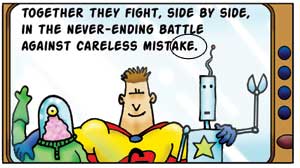
You'd be surprised at the number of grammatical points covered in comics, because they often rely on them for their humour. Where a point is being illustrated be sure to take it out, because a short illustration in a comic is far more valuable to students than a boring grammar presentation. Also many comics are designed to be black and white, so they are easy to photocopy.
Read the whole first strip of Grammar Man here. (272KB JPG)
This page was made possible thanks to the drawing talents of Brian Boyd. Please visit his site for more ELT comics.
Cartoon Story Maker
Cartoon Story Maker is a great little application for quickly making comic strips, which can either be printed out, shared on an interactive Whiteboard or saved to a Website. Here is an Example presentation.
Useful WebsitesGrammarman Comics.com Go Comics Garfield Snoopy Dilbert Asterix
The Viking |